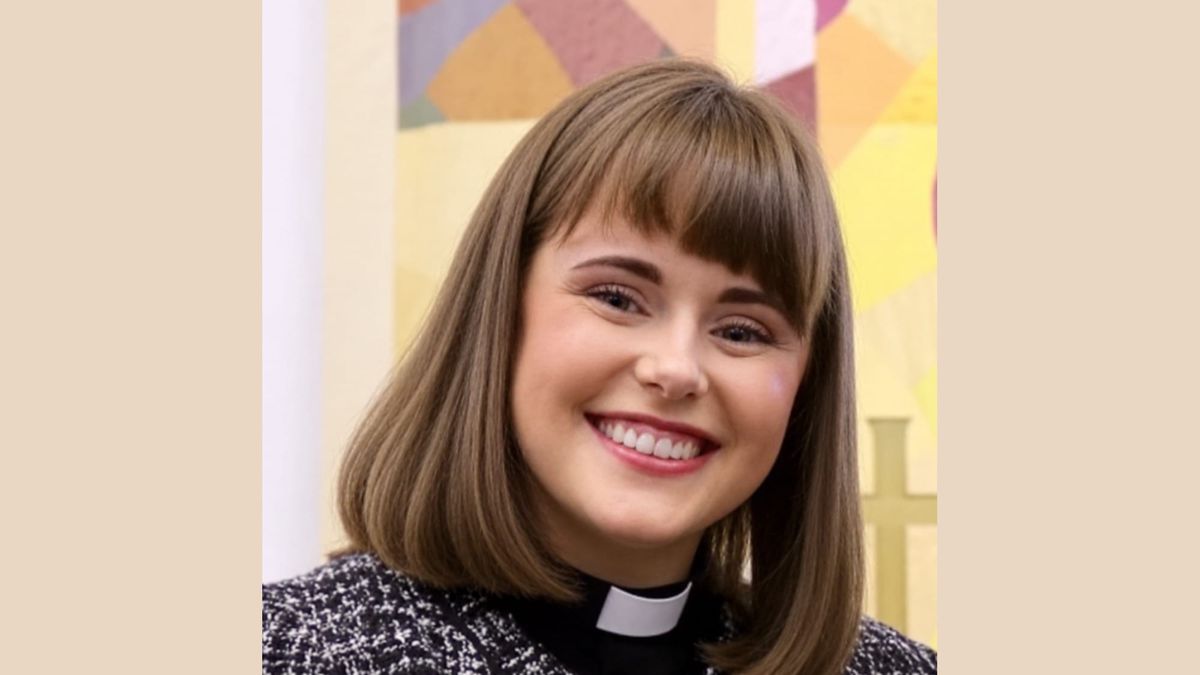
She was twelve when she went into hospital and had to learn to walk, to read and to write again. When she came back, her friends had moved on, and the only place she felt she belonged was church.
Av Maria Solbak Årnes · Video conversation with Sarah Parkinson, minister in the Church of Ireland, outside Belfast, Northern Ireland · 29 September 2026 · 15 October 2026
Two churches outside Belfast
MARIA Tell me about yourself, and where you are working.
I'm Sarah, I'm 32. I'm an only child. I grew up in a very loving home, a Christian home, but my parents always made me very aware that it was my decision as to whether I wanted to follow Jesus, or what I wanted to believe in.
I have two churches here where I am now. I'm just outside of Belfast. If I was somewhere else it would be a very different context, and a different ministry as well, especially in Northern Ireland.
I'm married to a man named Daniel, and Daniel is a classroom assistant for special needs children in a secondary school. That's where his gifts lie. I couldn't do it, but he does it very well.
The book her mother gave her
MARIA How did your own faith begin?
I went to church with my parents from a young age and attended Sunday School. It was always implemented that it was my decision as to whether I wanted to follow Jesus.
I was probably around six years old when my mum gave me a little book called Who is Jesus? And I read the book, and I asked my parents if I could follow him.
So, a very young age, and it probably didn't mean a whole lot at that stage of life, apart from saying my prayers before bedtime and going to Sunday school.
My mum gave me a little book called Who is Jesus? And I asked my parents if I could follow him.
The year in hospital
It became stronger in my life when I was in my teenage years.
I was really sick when I was twelve or thirteen, and I was in hospital for quite a long time. I think it got me questioning where I belong.
And when I did eventually go back to school, all my friends had kind of moved on. I had grown up a lot, and in that time I had to. And the only place I felt I belonged was church. Because the minister's wife had the same illness that I had, when she was younger as well. She kind of got alongside me, and I had to learn to walk, and to read and write again.
I felt like I belonged there. So I got really involved in church, more than I did in school.
The only place I felt I belonged was church.
I really felt a strong sense of calling to study theology.
I wasn't academic in any sense. In fact, I failed my religious studies exams. Quite a number of times, actually. But my teacher had faith in me, and she got me through it.
I thought I would go to Bible college and study theology for just a little while, and then go and do something that I was really passionate about. I was working in pharmacy, I was a dispenser, and I loved the healthcare side of things. And I was really good at business, so I thought I'd go into that.
But actually, I just got a love for studying theology, and went and did a placement in a hospital. So it brought my passion for healthcare and my faith together. Being on the other side of the bed, ministering to people when they're at probably their most vulnerable.
I failed my religious studies exams. Quite a number of times, actually.
Like Moses
I started doing pastoral visits in my church. And my minister at the time said to me: would you ever consider ministry full-time?
I said yes, in the sense that maybe I could be a pastoral visitor full-time, or I could go and do hospital chaplaincy full-time.
But then this whole idea of ordination came in. And initially I very much said no way. I was very much like Moses, in that I described myself as not eloquent enough. I was too young. There's no way I can move away from my parents. I just brought up all these excuses.
So my minister then said: well, what scares you the most? What are you most afraid of?
And I said, probably the academic side, but also speaking in front of people. Like, how do you do that?
So he said: that's okay. You're going to speak in front of people. You're going to write your first sermon, and you're going to preach on this date. And I'll help you with that.
To be fair, it took me at least four days to write a sermon. And he guided me along.
I was very much like Moses. I described myself as not eloquent enough.
Pushing the door
MARIA What kind of church was that?
That would have been [Lisburn] Cathedral. When you hear cathedral, you almost assume something else. But it would be very modern worship, very contemporary. A worship band, that kind of thing.
There was an early service with a choir and hymns, and the minister in robes. And then there was coffee, and in between the two services the two congregations would meet. So it wasn't them and us, they met for coffee. And then the second, more family-friendly service would begin, with the worship band.
So while I was preaching, I very strongly felt God telling me to go. And I was actually preaching on Moses.
And I thought, well, I'll go and push the door. And if it opens, it's his plan. And if it doesn't, then that's okay, there's something else.
And I knocked the door, and it opened. And went through the interview process. And that's how I ended up going forward for this kind of ministry.
I'll go and push the door. And if it opens, it's his plan.
MARIA So you would say you have a calling?
Yes. I mean, there are some days that I really think: Lord, why?
But I think in all vocations, in all jobs, in all careers, you have good days and you have bad days. And I think the same goes for ministry.
I think sometimes there's this perception that ministers only work on a Sunday. Or that you get to study your Bible all day, every day, and drink coffee, and it's great. But actually, there's so much more to it.
Probably not, and it's changed a lot from when I started.
I guess I just thought that I would have more time for my own study, and that I would be able to get out visiting. That's the bit that I love the most: sitting with somebody in their living room and hearing their story. Where they're at now, and how God has impacted their life.
So maybe I don't get to do as much of that as I had hoped. There's a lot of admin, a lot of legal work in terms of safeguarding and issues like that.
The doorbell
MARIA Was there ever a time when you were unsure of your calling because you are a woman?
Yes, as I said, I have some really tough days. I ask: is this really what you want me to do, God? I think it's a question I ask every single day. If this is right for me, keep leading me through the way.
I always feared that maybe I wasn't following his plan. But someone wise told me: if the door's open, it's of him. And if it's not of him, it will not happen.
I struggled with it a lot at the start. I had friends that I studied with who were of a different denomination than me, and didn't believe in women in ministry. And so that friendship broke down, because of what I felt that I was being called to.
But it was respectful, to know they had a belief system that wasn't in line with mine. And that's okay, that's what they believe. But I really felt that God was calling me to this, so I pursued that.
That friendship broke down, because of what I felt that I was being called to.
I've never had a major confrontation from anybody.
Sometimes people are still very used to it being male-dominated. Sometimes somebody will ring the door and ask for my husband, because they assume he's the minister, when it's actually me. But that's what people have been used to. There's no hurt or offence in it at all.
You kind of know when someone doesn't believe in it. And that's okay, we all have our own beliefs and our own interpretations of Scripture. But you might have someone that maybe doesn't talk to you, or you might see a conference advertised that you'd really like to go to, but it's only for men. And leadership, that kind of thing.
Somebody will ring the door and ask for my husband, because they assume he's the minister.
Eight months pregnant, up into the pulpit
I've found it really challenging since becoming a mother.
A lot of women who are in ministry, not all, but a lot, have had a career and had a family prior to coming to ministry. When I first went into ministry, there was no maternity policy. It took us quite a long time to have our daughter, and by the time she came there was a maternity policy. But I found that there were just some holes in it.
Six months on full stipend. I took seven in the end. If it's a male minister, they get two weeks full pay. And they've now also incorporated adoption, which I think is progress.
I panicked when I was going back. I didn't know what that looked like, because there were very few other people my age in the same situation.
And getting childcare, because it's not a nine to five, was a wee bit more difficult. My daughter couldn't be up beside me. And then I was thinking: I need to stop feeding her, I need to feed her by bottle now. It was all those things that come into play.
We had a very high pulpit in that church. And at eight months pregnant I was still to walk up into the pulpit, rather than being able just to stand on the ground.
I just think we could make a few more provisions for women in ministry. And I would love to be the person that does that. But I'm still very newly in.
At eight months pregnant I was still to walk up into the pulpit.
And when I had our daughter, there were a couple of parishioners who said to me: well, are you going to leave work now? And I said no. As if that was what was going to happen.
I'm very fortunate, I have a very understanding congregation. They don't ring the doorbell past her bedtime. They know that she's going to be running up and down to me during the service, because I'm her mum. And that's who I am to her, first.
A couple of parishioners said to me: well, are you going to leave work now?
He didn't hate women
I think we have this view that he hated women, but I don't actually think he did.
We have to remember when he was writing. First and foremost, women didn't have a position in society. They didn't work. They were simply there to manage the home and the children, and that was their place. So this wouldn't have been radical in any sense, what he was saying. It probably would have been normal.
I think the fact that Jesus challenged that, and talked with everyone. It wasn't just the outsiders and the outcasts. He talked with the tax collectors, with children, with women. Everybody was included.
It's so easy for us to take a text anywhere, including Paul, and bend it to what we want it to mean. I was running a course last week for people who are new to faith, and someone was saying: but surely the Bible says that murder is all right, because it happens so much in the Bible. We do take it and bend it to what we want it to mean.
But I think it's really important that we look at the background. What did this mean to the original people? But also, what does it mean for us today? Because it's not a historical document that gets put on a shelf and is of no use to us. It's actually very relevant for us today.
It's always my fear that I take something out of context, or that that's not what God meant when he inspired those words.
It's always my fear that I take something out of context.
I think it's so important that we read Paul's letters, that we don't forget them, just because we don't like something that they say.
That actually we take it and say: right, this is what it originally meant, which was perfectly normal, would have been okay. And this is what it means for us today in our context. His was very different to ours. And people's context in fifty years' time will be very different to now.
It's so important that we don't forget Paul's letters, just because we don't like something that they say.
MARIA He also reasons from creation, from Adam and Eve, and sets out an order. What should we take from that today?
I think we have this idea that he is a woman hater. I don't agree. I think he just wanted the best for people.
I think he wanted people just to love God, and to be shaped and moulded by him. And he did it in the way that he believed was aligned with God's plan, but also that was best for society and for his context. And that's going to be very different for us. We're going to align with God's plan, but at the same time our context is very different.
He had had such a dramatic change in his life. I think he was a man that was just filled with so much joy for God, but was just frustrated at everybody else. You need to be like this too. You need to feel this as well. This has changed me, and it can change us too.
He probably looked at the world around him and felt quite sad about what was going on. And probably quite troubled by it, which we can all resonate with.
She said twice that she wanted to write a fuller answer about Paul and send it. It had not arrived when this draft was made, and the space below is hers.
I think he just wanted the best for people.
The women of Holy Week
MARIA Jesus challenged Paul, you said. How?
I think he challenged everybody, I don't think he just challenged Paul.
They had an idea of who he should be, what he should look like and what he should do. There was a lot of expectation. He didn't live up to that. We know the end of the story, they didn't. A lot of them didn't recognise him for the Messiah. They mistook a whole lot of other people to be the Messiah, because he wasn't who they thought he was going to be.
And I think that is something for us about our expectations. Do we assume that God thinks a certain way, looks a certain way, will do certain things?
Even just talking to people who had leprosy, never mind touching them. And going and sitting in people's homes that were supposedly unclean. He met people where they were at, not where they should be. And he does the same for us today.
It wasn't just that he challenged the men on their view of women. He challenged women too. Look at Mary and Martha. He rebuked them when he thought something was wrong.
People sometimes say Jesus had a soft spot for women. He just welcomed them as he would welcome any man.
People sometimes say Jesus had a soft spot for women. He just welcomed them as he would welcome any man.
There is a really good book by a theologian called Paula Gooder. She wrote a book called [The Women of Holy Week]. It was about the women that had a big impact on that week of all weeks.
I found it so interesting, because you just see them in the background. You hear their names, but you don't actually know what they did.
I had hoped at one stage to do a sermon series on based on the women of Holy Week. But I got told by a male colleague that the men in the congregation wouldn't be interested in that.
I got told by a male colleague that the men in the congregation wouldn't be interested in that.
The twelve
MARIA Jesus chose twelve men as his closest disciples. Some say that means the head of a church should also be a man, because Jesus is the example. What is your answer?
He may have chosen the twelve as we know them, as we refer to them as his disciples. But actually there were disciples who were women. There was [Lydia]. There are so many to look at who had such a big impact on his ministry.
MARIA So you don't think the twelve were chosen because they were men?
I don't think we should read into it too much. No.
I don't think we should read into it too much.
Respecting one another
I think that's really important: that we do just respect one another. We are all going to believe different things. But that's okay.
We are all made in the image of God, and yet we're all going to believe such different things.
Portrett
Terskelen
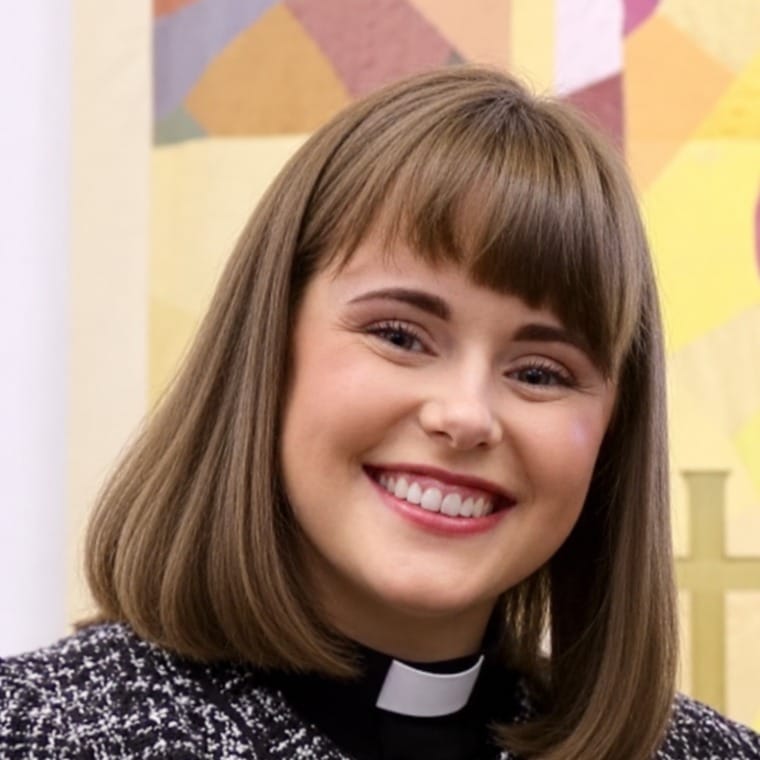
Parkinson is the youngest woman in this series, and the only one who came to the church through a hospital ward. Twelve years old, a long stay, learning to walk and to read again, and a minister's wife who had had the same illness and came alongside her. School had moved on without her. The church had not.
Her account of the calling is the most physical in the series. She refused ordination with the excuses of Moses, was handed a date and told to write a sermon, took four days over it, and preached on Moses. Then she pushed the door.
On the disputed texts she does not go where most of the series goes. She does not say the letters have expired. She says the opposite: that we must not forget Paul's letters just because we do not like something they say, and that the danger is bending a text to mean what we want.
Two questions remain for the editor. If a passage meant one thing then and another now, who decides which part travels? And she answers the question about the twelve by saying we should not read into it too much. The other side reads a great deal into it, and will say that refusing to read is not an argument. They have the floor before we pass judgement.